
Before I begin, a brief apology.
Some readers may find this review a bit sharp. If so, I ask for your forgiveness in advance. The reason is simple: one of my biggest frustrations with the UFO community is not the lack of evidence, but the lack of critical thinking. Too often, extraordinary claims are accepted with little scrutiny simply because they support a preferred narrative. A story doesn’t become true because of what someone wrote or said, or because it is exciting, comforting, or confirms what we already believe.
As someone who has spent decades wrestling with unusual experiences of my own, I have every reason to want certain claims to be true. But wanting something to be true and it actually being true are very different things. As Carl Sagan once said, “It is far better to grasp the universe as it really is than to persist in delusion, however satisfying and reassuring.”
If we expect skeptics to take the UFO phenomenon seriously, we must be willing to apply the same level of scrutiny to our own beliefs that we apply to mainstream explanations. Otherwise, we risk becoming believers rather than investigators. So, with that in mind, let’s examine some of the claims made in this book that do not pass scientific scrutiny or critical thinking.
The Science
1) The Cow Problem
The book claims aliens abduct and mutilate cows for their genetic material because ET is experimenting with the human genome and bovine DNA is supposedly the closest match to humans. How thoughtful of them. Rather than experimenting on humans, they choose to mutilate cows instead. There’s just one problem: cows are nowhere near the closest genetic match to humans. Cattle share roughly 80% of their genes with humans. That’s impressive until you remember that chimpanzees share approximately 98% of our DNA.
Chimpanzees too cuddly to abduct? Fine. Grab a few mice. They share around 92% of our genes. Scientists use mice extensively in biomedical research precisely because of their genetic similarities to us. And, hey, humanity would probably be less upset about a missing rodent than finding another mutilated cow dumped in a farmer’s field.
And here’s the bigger problem. A civilization capable of crossing interstellar distances would only need to sequence a cow’s genome once. After that, they’d have the complete genetic blueprint forever. We can already sequence genomes and synthesize DNA today. Surely a civilization thousands, probably millions of years ahead of us could manage the same feat without repeatedly raiding the local cattle population.
Which raises an interesting question: if ET only needs a human genetic sample once, why would they supposedly continue abducting humans decade after decade? But that’s a topic for another blog post and perhaps another chapter in my book.
2) The Rh-Negative Myth
The book also claims that aliens engineered humans from rhesus monkeys and that Rh-negative blood is evidence of this connection. This is one of those claims that sounds scientific until you spend about five minutes looking into it.
The Rh factor does indeed get its name from the rhesus monkey but not because humans originated from rhesus monkeys. Scientists first identified a related blood-group antigen while conducting experiments involving rhesus monkeys, and the name stuck.
That’s it.
The presence of Rh-negative blood does not suggest extraterrestrial engineering, hidden ancestry, or alien intervention. In fact, Rh proteins are remarkably widespread throughout nature. Variations of Rh-related molecules are found across many forms of life, including fish, algae, and even certain bacteria.
More importantly, the human genome has been mapped in extraordinary detail. Our DNA tells a remarkably consistent story of common ancestry with other life on Earth. Evolution is not inferred solely from fossils; it is written directly into our genetic code. Basically, our DNA is effectively a history book containing millions of years of evolutionary history.
If extraterrestrials had inserted themselves into human evolution, geneticists would find evidence of such an intervention. Instead, what we find is exactly what evolutionary theory predicts. Now, at this point, someone inevitably raises their hand and says, “Ah yes, but what about junk DNA? That’s where the aliens hid the evidence!”
No.
Scientists know what “junk DNA” is. The term refers to portions of the genome that do not directly code for proteins. For years, some researchers believed much of this DNA served little purpose, which is how it earned the unfortunate nickname. Today we know that much of this so-called junk DNA plays important roles in gene regulation, chromosome structure, and other biological processes.
Second, Critical Thinking
1) The Galaxy’s Worst Drivers
As mentioned elsewhere, the idea that a civilization capable of traveling trillions of miles across interstellar space would repeatedly crash on Earth stretches credibility. Once? Perhaps. Twice? That’s unfortunate. Dozens of times? Well, at that point we’re no longer dealing with advanced visitors. We’re dealing with the galaxy’s worst drivers.
Surely a civilization capable of mastering faster-than-light travel, wormholes, or whatever exotic technology gets them here could also figure out how not to plow their spacecraft into the desert every few years. The number of alleged crashes often seems inversely proportional to the competence one would expect from an advanced civilization.
Granted, I can think of one logical explanation for these crashes: They were intentional.
If a non-human intelligence wanted governments to recover its technology, leaving behind a craft would certainly get their attention. Why might they do this? I can only speculate. Perhaps it was a form of controlled technology transfer, allowing humanity to reverse-engineer small pieces of advanced technology at a pace it could handle. Perhaps the goal wasn’t the technology at all, but the institutions that would grow around it such as secret programs, intelligence operations, and a culture of secrecy (this last one would go far in ET’s apparent need to keep their presence secret to most earthlings). Or perhaps the crashes were intended to gradually acclimate humanity to the idea that we are not alone, making the eventual reality of extraterrestrial life less shocking.
So, if we’re choosing between “a civilization advanced enough to cross the stars keeps accidentally crashing” and “the crashes served a purpose,” the latter strikes me as the more plausible of the two. And thus, maybe they aren’t the galaxy’s worse drivers. But still, wouldn’t just a few “crashes” serve their purpose?
2) The World’s Least Secret Secret Program
At one point in the book, a newly recruited spacecraft-recovery cadet undergoes a super-secret training program where he is briefed not only on his assignment but apparently on nearly every other classified UFO program imaginable.
The first part is believable. If you’re joining a highly classified project, you’d probably receive some background on the project itself. But then the story abandons one of the most fundamental principles of intelligence and military operations: compartmentalization.
The entire purpose of a “need-to-know” system is that people only receive information necessary to perform their jobs. If everyone in a secret program knew all the secrets, the program wouldn’t remain secret for very long. Secrets would leak like a screen door on a submarine.
3) The Alien Hybrid Who Somehow Blends In
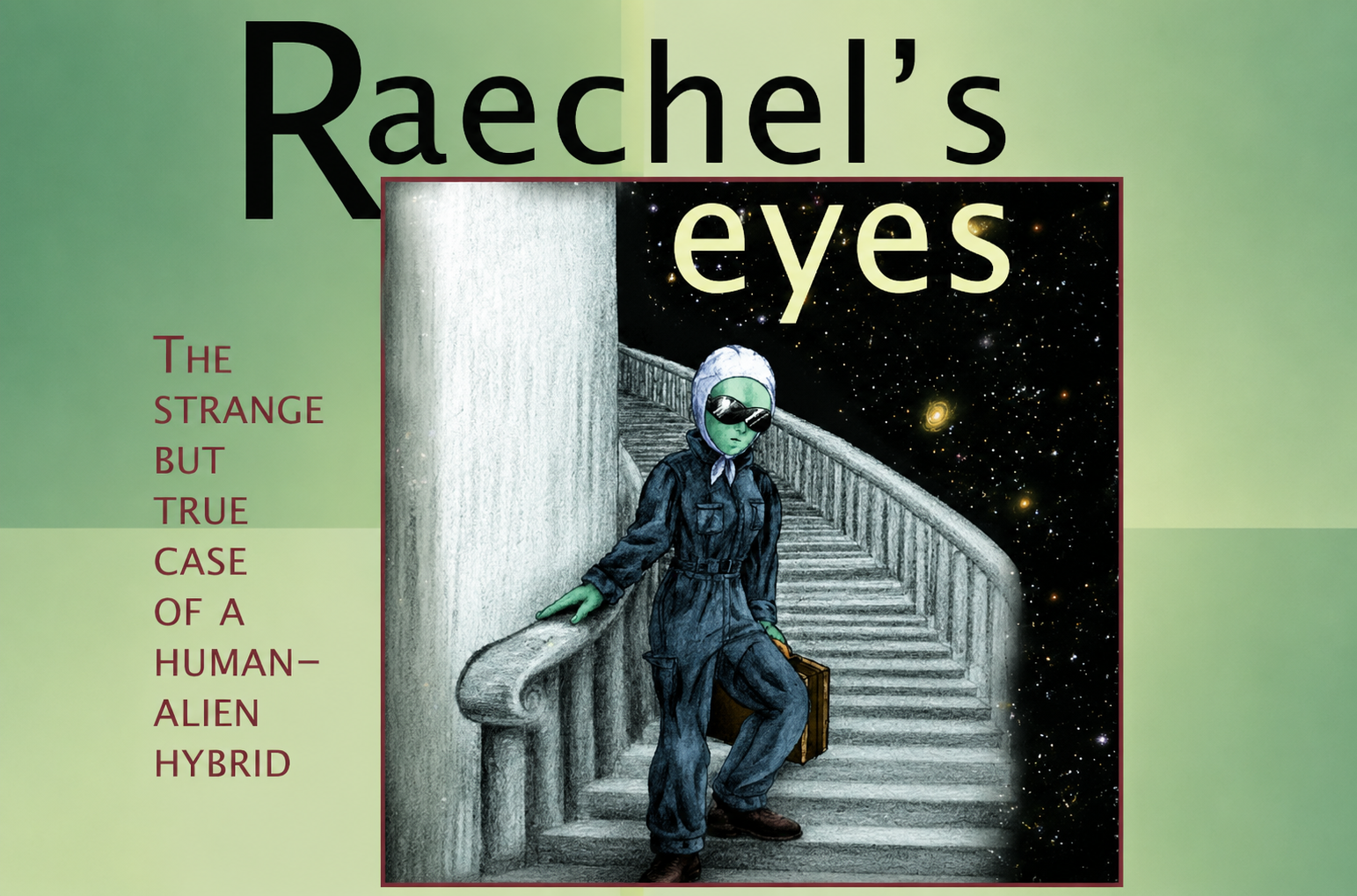
Perhaps my favorite claim involves Raechal, an alien hybrid, living openly among humans. Think about that for a moment. We’re told the military is desperately trying to keep aliens secret while simultaneously allowing an alien hybrid to attend college courses, interact with roommates, and generally wander around society. I dunno, but that seems… risky.
How many people with greenish-yellow skin, oversized eyes, and unusual physical features have you encountered at your local community college recently? Sure, the character wears oversized glasses to conceal some of these features. Apparently the military’s top-secret disguise technology is roughly equivalent to a pair of spectacles from the discount rack.
At some point she would trip, lose the glasses, get photographed, or otherwise become the most discussed person on the internet. The plan seems less “top-secret government operation” and more “let’s hope nobody notices.”
And why would a being possessing knowledge supposedly far beyond human understanding need to attend community college in the first place? One would think an advanced extraterrestrial intelligence might have already mastered Intro to Psychology.
But I digress.
The notion that a military organization would allow an alien hybrid to live openly among the public while simultaneously trying to conceal the existence of aliens is not merely scientifically questionable, it fails a basic critical-thinking test.
Final Thoughts
Unfortunately, the book offers very little evidence and asks the reader to overlook an enormous number of scientific, logical, and practical problems. As fiction, it’s entertaining enough. As nonfiction, however, it asks readers to suspend not only disbelief, but also genetics, evolutionary biology, military procedure, and occasionally reality itself. And that’s a rather large ask.
