
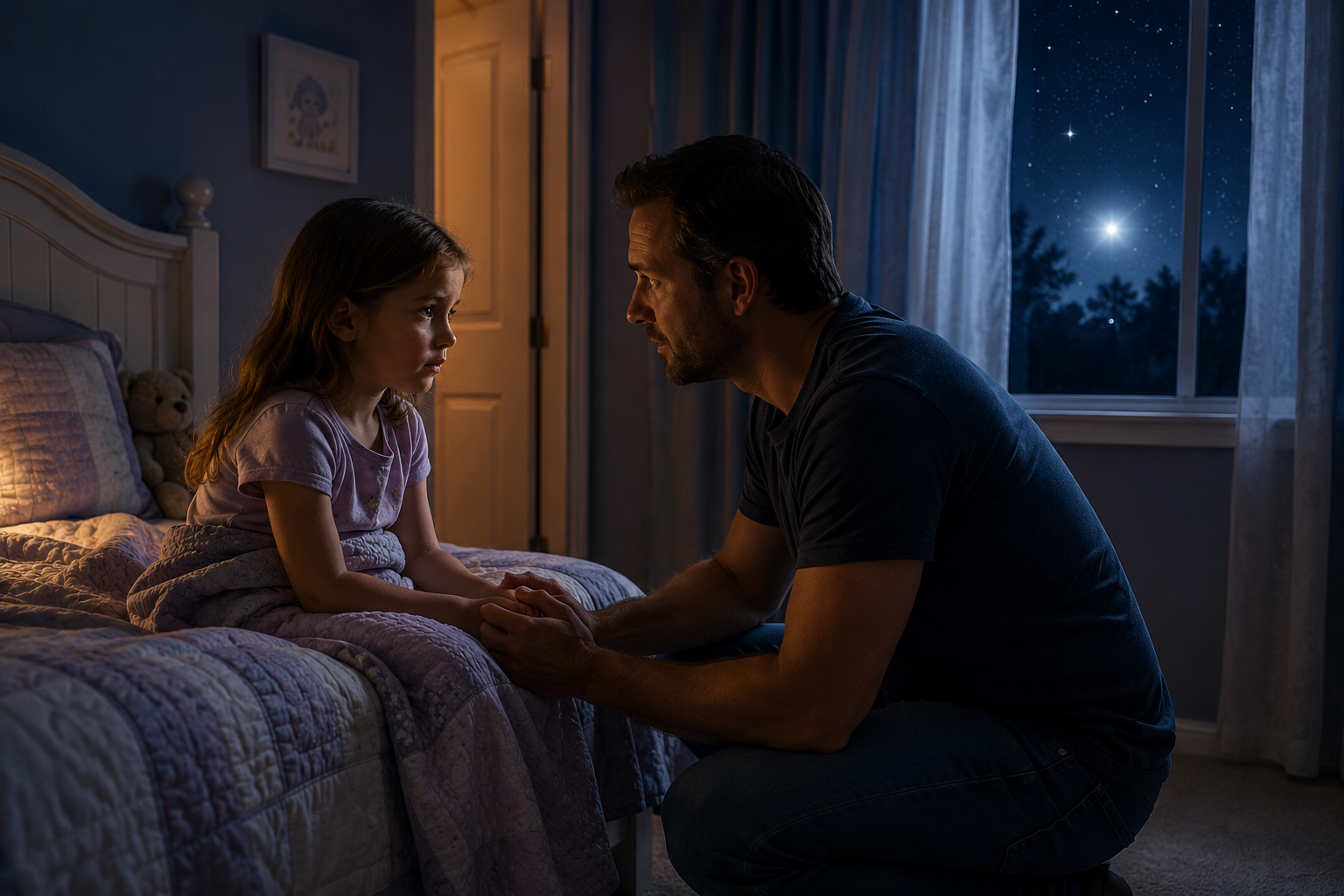
Years ago, when my first child was born, I dived deep into research, learning everything I could about helping children cope with these traumatizing experiences. I love my children and I want to do everything humanly possible to help them navigate whatever terrors they may encounter.
Recently, I came across the notes I collected during that time and thought it would be a good idea to organize them into an article so other parents may have some guidance on how best to approach this with their little ones.
It is my sincere hope that what I share here may help other families cope with these unwelcome visitors and provide some comfort during what can be a confusing and challenging journey.
Start With the Child, Not the Phenomenon
When a child wakes up frightened and tells you they saw a creature in their room, the most important question is not whether the experience was objectively real. The most important question is, “How is my child feeling right now?”
Children need emotional safety before they need answers. Many parents make one of two mistakes. They either 1) dismiss the experience completely or 2) overload the child with frightening theories and explanations.
Neither approach helps. Instead, focus on creating an environment where your child feels safe where they are open to discuss anything they experience. A child who feels heard is far less likely to develop long-term fear than a child who feels isolated or ridiculed.
Listen Without Judgment
Allow your child to describe what happened in their own words. Avoid saying things such as, “It was just a dream.”, “That wasn’t real.”, “It was definitely aliens.”, or “They won’t come back again”.
Instead, try, “That sounds like it was very real to you.”, “Can you tell me more about what you experienced?”, or “How did it make you feel?”
Your goal is not to interrogate. Your goal is to understand. Children often reveal the most useful information when they are allowed to speak freely without pressure.
Use Your Child’s Language
If your child calls it a dream, discuss it as a dream. If they call it a visitor, discuss it as a visitor. If they call it an alien, discuss it as an alien. Using their language communicates respect and reduces confusion. You want to avoid imposing interpretations that the child did not express.
Marcie of Open Box Counsuling had written me, explaining:
It’s best to use your child’s language. If they say it was real then acknowledge that it’s real but that you have always been returned safely. If they say it’s a dream then talk about it like it’s a dream. It’s also best to not give them too much information. I only answered questions that my son asked me directly until he was much older. That’s my advice.
Reassure Safety
One of the most powerful messages a parent can give is, “You are safe. I am here with you.” Children need reassurance far more than explanations. It can also help to remind the child, “You have always come home.”
The goal is not to convince them nothing happened. The goal is to reduce catastrophic thinking.
Do Not Transfer Adult Fear
Children learn how to interpret unusual experiences by watching the adults around them. If parents appear terrified, angry, or obsessed, children often absorb those emotions. If parents remain calm, curious, and supportive, children are more likely to remain emotionally stable.
Children do not need to carry the weight of adult theories, fears, or uncertainties.
Avoid Leading Questions
Instead of asking, “Did the alien take you?”, “Did they perform tests?”, or “Was it a gray?” Ask, “What happened next?”, “What do you remember?”, “How did you feel?” This is important becuase leading questions can unintentionally shape memories. Allow the child to describe the experience in their own way.
Help Children Regain a Sense of Control
Fear often comes from feeling powerless. Children benefit from having choices. For instance, let them choose where they sleep, choose their own nighlight, choose the calming music they’d like to drift off to sleep to, or choose a comforting stuffy to share their bed with. Even small choices help restore a sense of control.
Create a Safe Sleep Environment
Many children report experiences at night. So helpful strategies include having nightlights, white noice machines or, our favorite, calming night music, closed curtains or blackout shades, and have comfort items nearby such as stuffed animals or blankets.
The goal is not to stop the experiences. The goal is to help the child feel secure enough to sleep peacefully.
Encourage Creative Expression
Children often communicate experiences through play and art before they can fully describe them with words. So, encourage drawing, storytelling, journaling, or building scenes with toys. These activities can reduce anxiety and help children process emotions.
Importantly, avoid interpreting every drawing as evidence. Let the child explain their own artwork.
Normalize Discussion
Many children become frightened because they believe they are alone. Let them know they can talk about their experiences without getting in trouble or being ridiculed. Children who feel accepted are less likely to develop shame or chronic anxiety.
“I Believe You”
A powerful phrase that makes your child feel accepted and heard is “I believe you”. When a child tells a parent about something strange, frightening, or difficult to explain, the child is often seeking something more important than an explanation. They are seeking reassurance that their experience matters and that they can trust the person they are telling.
Saying, “I believe you”, allows the child to feel heard and validated without forcing the parent into a particular explanation. Children often look to parents to determine how they should react to an experience. If a parent responds with panic, the child learns the experience is terrifying. If a parent responds with ridicule, the child learns the experience is shameful. If a parent responds with calm acceptance, the child learns that unusual experiences can be discussed safely and openly.
In many ways, “I believe you” is less about establishing what happened and more about preserving trust. A child who feels believed is more likely to continue sharing their experiences. A child who feels dismissed may stop talking about them entirely.
For a child reporting strange experiences the most valuable gift a parent can offer is often not an answer, but a safe place to ask questions. As author and educator Fred Rogers often emphasized in different ways throughout his work, children need to know that their feelings are mentionable and manageable. When a parent says, “I believe you,” they are telling the child they are not alone in this and that you are listening to them.
That may be far more important than determining what this experience exactly is. For most children, the relationship with the parent is what matters most.
Watch for Signs of Trauma
Most children appear resilient and adapt well. However, some may need additional support. Look for these warning signs:
- Persistent nightmares.
- Bedwetting after being previously dry.
- Severe separation anxiety.
- Sleep refusal.
- Panic attacks.
- Ongoing fear that interferes with daily life.
- Social withdrawal.
- Depression.
If these symptoms appear, professional support may be helpful.
Seek Professional Help When Needed
If a child’s distress becomes significant, consider consulting a licensed child psychologist or therapist. The ideal professional is one who respects the child’s experiences, does not ridicule the family, and focuses on emotional well-being rather than proving or disproving the phenomenon.
When you contact them, I’d be very direct:
I have experiences that I interpret as possible alien-abduction experiences. I’m not looking for someone to prove or disprove them. I’m looking for someone who can discuss them respectfully and help me process them without immediately assuming they’re delusions or, conversely, automatically assuming they’re extraterrestrial.
The therapist’s role is not to determine whether aliens exist. Their role is to help the child feel safe, resilient, and emotionally healthy.
Remember What Children Need Most
Children rarely need parents to solve every mystery. What they really need is safety, calmness. honesty, emotional support, someone who believes that their feelings matter. Whether the experience turns out to be a dream, a psychological event, or something genuinely unexplained, the same principle applies:
A child who feels heard, protected, and loved is far more likely to grow into a healthy adult than a child who feels alone with their fears.
Practical Advice From an Experienced Experiencer
While researching this topic, I came across a set of recommendations from a longtime experiencer and parent who had previously spoken publicly about helping children cope with unusual nighttime experiences. Although I can no longer remember who originally shared these insights with me, I thought their advice was worth preserving because it closely aligns with what child psychologists often recommend when helping children process frightening or confusing events.
What struck me most was that the focus was not on proving what happened or explaining every mystery. Instead, the emphasis was on helping children feel safe, heard, and supported. Whether a parent interprets these experiences as dreams, contact experiences, or something else entirely, the emotional needs of the child remain the same.
The following points are reproduced from my notes and are shared in the hope that they may help other families navigating similar situations. Unfortunetly I did not record who wrote this but still, it is a good summary:
Shepard, I think the best thing you can do is to let your child know that they are not alone. Here are some are some points I shared in a talk I gave a few years ago:
1. Listen to them and honor their experience.
2. Use the child’s language; if they say it’s a dream, talk about it like it’s a dream. If they say it’s real, talk about it like it’s a real experience.
3. Reassure them that they have always been returned safely and so have you.
4. Always answer their questions as simply and honestly as you can, only giving them the answer they have asked for.
5. If your child doesn’t seem to be distressed by their experiences then refrain from giving them information that may confuse or scare them.
6. If they are experiencing fear about their experiences then help them to come up with coping strategies to deal with the fear.
7. Children look to us to tell them how to perceive their experiences. If you are fearful and unsettled by your encounters, you must be mindful of how you communicate with your child about it.
Here is a list of coping strategies for children:
1. Give them a nightlight to sleep with and think about getting an ambient noise machine with calming soothing sounds for sleep.
2. Sometimes a child will feel more secure with opaque window shades closed at night.
3. Orient the child’s bed in a position that makes them feel more secure, away from the window or closet can often be helpful.
4. It can be very helpful to children to have them draw what they have seen or experienced, as a way to express it when they may not have the words.
5. If they believe in a religious or spiritual figure, praying to them may help or repeating certain words or phrases can be comforting.
6. If your child is old enough, have them write a letter to the beings expressing what they like and don’t like about the experiences.
Facing This Together
For me and I’m sure for many parents, the most difficult part of a child’s unusual experiences is the feeling of helplessness. If your child is frightened and you don’t know how to stop what is happening or even understand what is happening, it is natural to feel fear, frustration, and uncertainty. As parents, we are wired to protect our children and few things are more unsettling than facing a problem for which there is no clear solution.
While I cannot promise that these experiences will stop, I hope what I shared here will help you navigate them with greater confidence and compassion. Remember that your child does not need you to have all the answers. They need your love, your patience, and your willingness to listen. More than anything, they need to know they are not alone.
A child who feels heard, believed, and supported is far better equipped to cope than one who feels isolated or dismissed. Perhaps the greatest gift we can give our children is not certainty, but the reassurance that whatever they face, we will face it together.
